


Data security has evolved from an additional layer on top of existing infrastructure into a core operational requirement. Organizations handling sensitive information — personal data, financial records, healthcare information — need to ensure that data is protected at every operation: when it is discovered, when it is transformed, when it is delivered, and when it is audited.
The problem is that most platforms address only one part of that cycle. Gigantics covers it entirely, from automated PII identification to governed delivery across any environment, with signed audit evidence at every operation.
These are the five reasons why teams in regulated industries choose Gigantics.
1. Automated discovery that keeps your inventory current
Knowing where sensitive data resides is the starting point of any data security strategy. Without that knowledge, controls are applied based on assumptions — and assumptions create exposure.
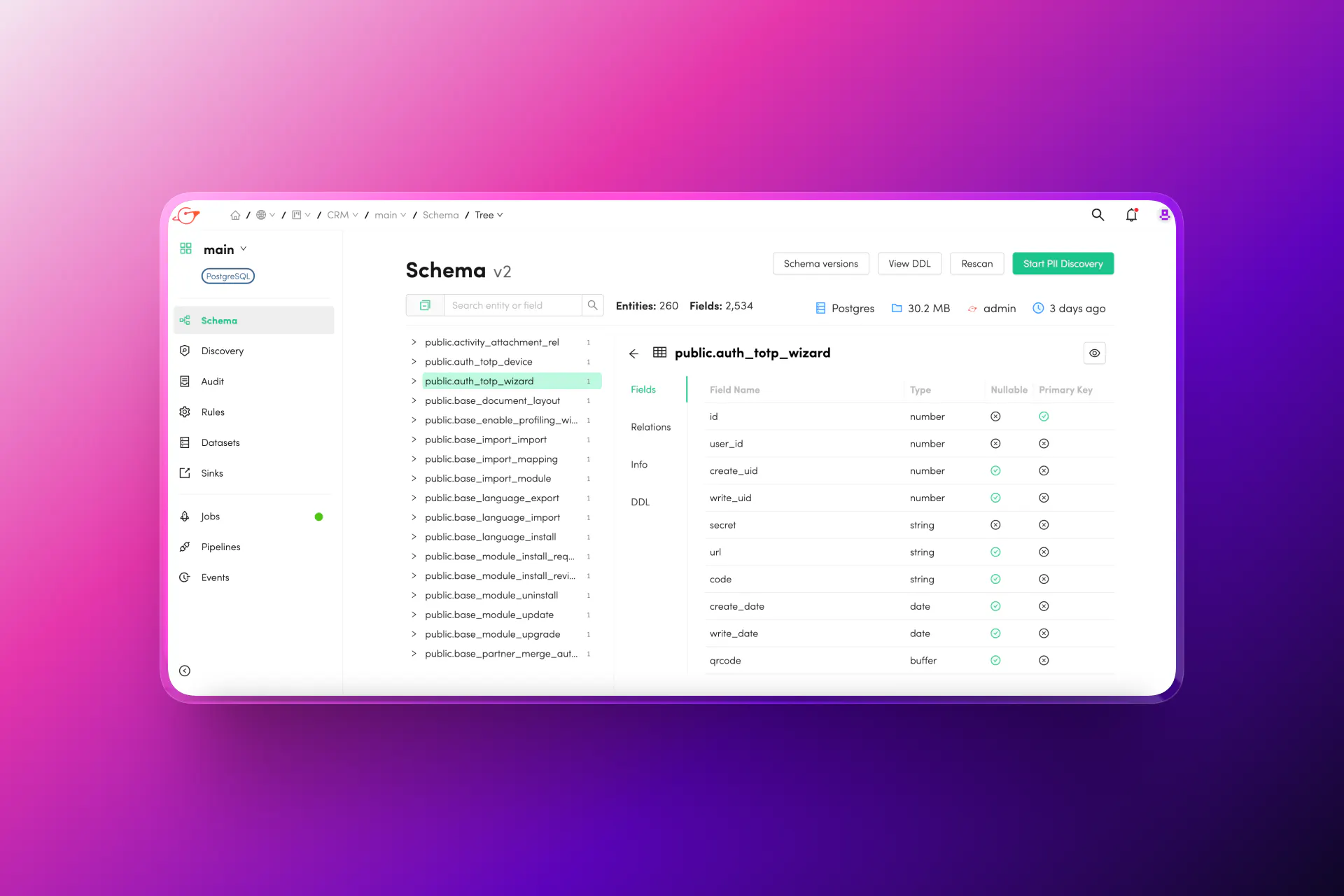
Gigantics automates this process through a continuous discovery engine. When a data source is connected, the platform scans schemas periodically, analyzing column names, data types, and sample values using machine learning models trained to identify PII patterns. Each field receives a confidence score, and results are displayed as heat maps that visualize risk distribution across the entire schema.
Every scan is automatically compared against the previous one, so any structural change is documented before it creates uncontrolled exposure. The inventory is not static — it evolves as your data changes.
2. Transformations that preserve referential integrity
Protecting sensitive data cannot come at the cost of its utility. Masking values in isolated tables without respecting the relationships between them produces inconsistent datasets: broken foreign keys, empty joins, and workflows that fail due to poorly structured data rather than actual application errors.
Gigantics offers three transformation models adapted to different risk levels and use cases:
- Anonymization — irreversibly removes personal identifiers, producing data that falls outside the scope of GDPR and can be used freely in analytics, development, or third-party sharing.
- Masking — replaces sensitive values with fictional but realistic ones, preserving the format and structure of the original data to ensure that receiving environments behave exactly as they would in production.
- Synthetic data — generates entirely new records that replicate the statistical distributions and business logic of the original schema, with no relationship to real data.
All three modalities are applied at the model level, ensuring that transformations are executed consistently across all related tables in a single operation. Referential integrity is fully preserved, regardless of schema complexity.
The result is datasets that maintain the business logic of the original — functional, compliant, and ready to be used in any environment.
3. Local-first architecture: data never leaves your own infrastructure
For organizations in regulated industries, where data is processed matters as much as how it is processed. Sending sensitive records to an external service for analysis or transformation constitutes a transfer that requires a legal basis, documentation, and risk assessment under frameworks such as GDPR, NIS2, or equivalent sector-specific regulations.
Gigantics operates entirely within the client's own infrastructure. The PII labeling engine, transformation functions, and dataset delivery all run locally. No data leaves the organization's environment to be processed externally.
This architecture eliminates an entire category of regulatory risk by design. Transfers that do not occur do not need to be documented or justified.
4. Governed delivery to any environment via API
Gigantics does not only protect data — it moves it. The platform manages the complete flow from sources (taps) to destinations (sinks), applying transformation rules at every operation to ensure that only compliant data reaches its destination.
Jobs can be triggered programmatically from CI/CD pipelines — GitHub Actions, GitLab CI, Jenkins — to deliver protected datasets on demand. Pumps automate the continuous refresh of downstream environments without re-exposing original records. Every delivery applies the same governance policies, ensuring consistency across executions and eliminating the variability introduced by manual processes.
Data delivery stops being a manual process and becomes a governed operational capability.
5. Signed, operation-level audit evidence
Demonstrating regulatory compliance requires verifiable evidence, not merely the existence of controls. Generic system logs do not meet the expectations of auditors operating under GDPR Article 32, NIS2, or equivalent frameworks, which require documentation of what data was transformed, when, through what process, and under whose responsibility.
After each discovery execution, Gigantics generates PDF reports that record this information precisely: who initiated the process, which labels were added, modified, or removed, who was responsible for each change, and the percentage of confirmed entities at the time the report was generated.
Reports can be digitally signed. Once signed, they cannot be modified or deleted — they reflect the exact state of the system at that specific moment. Audit preparation stops being a manual exercise and becomes a straightforward documentation process.
An Integrated Platform for the Complete Data Security Cycle
There is no need to integrate independent solutions for each stage or manage consistency across tools from different vendors. Gigantics executes the complete data security cycle locally, under the organization's own policies, and adapted to the team's delivery cadence.
Organizations that have deployed Gigantics have eliminated bottlenecks in data provisioning, reduced audit preparation time, and ensured that no sensitive data moves without governance.